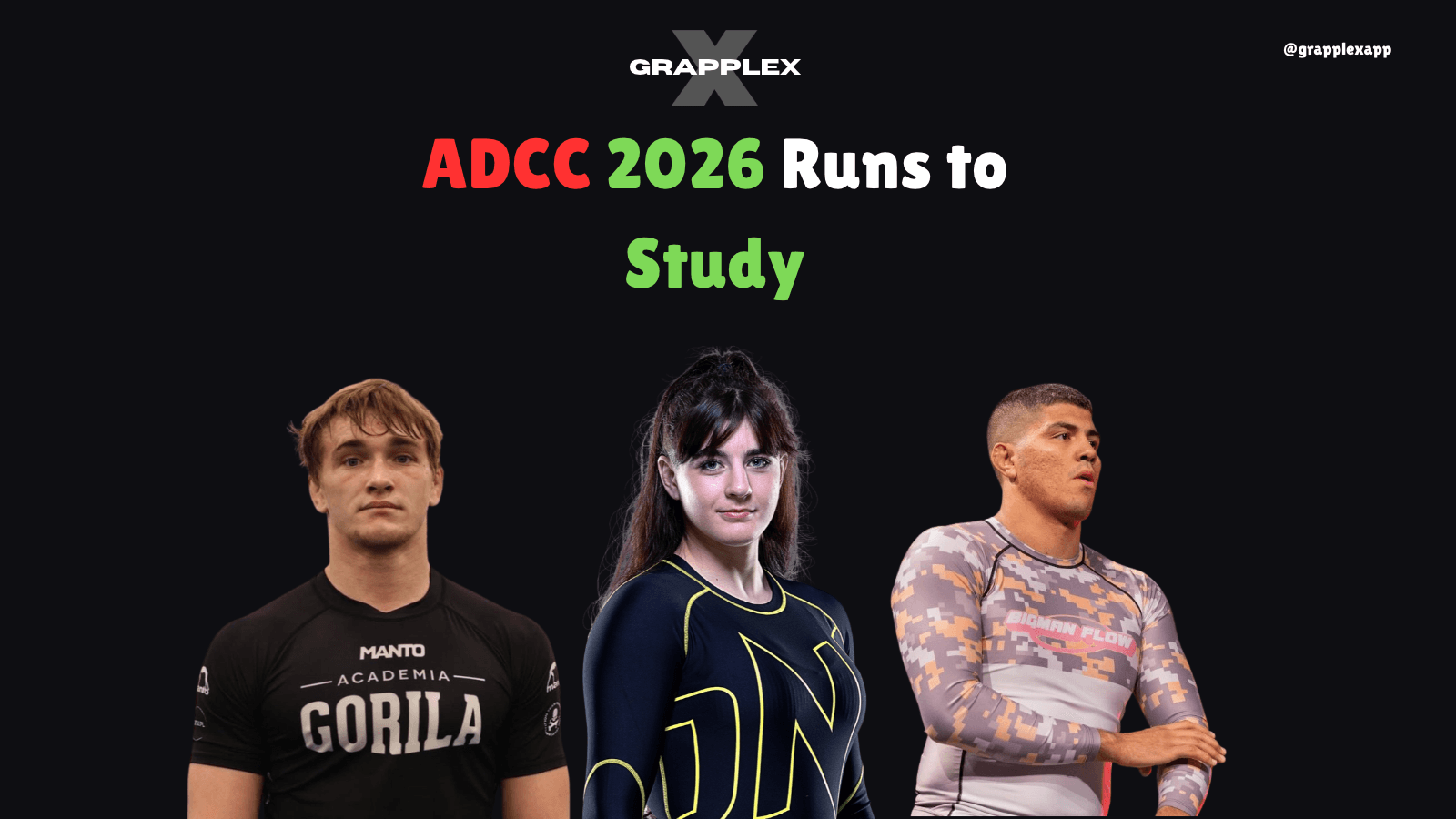
ADCC 2026 is done. Two days at the Tauron Arena in Kraków, eight divisions plus the absolute, and a weekend that produced a few champions nobody had circled beforehand.
Watching the event live is one thing. Going back and actually studying it is another. Below are five runs from the weekend that are worth rewatching properly — not for the highlight, but for the pattern underneath it. Each one is a complete, self-contained lesson in a specific style.
Pawel Jaworski — Leg Lock Masterclass
Men's -88kg gold. Three submissions on the way to the final, then a 0-0 decision over Marlon Tajik to become Poland's first ever ADCC World Champion, at 22, in front of a home crowd.
The run: Roberto Frias by submission at 6:10, then the No. 1 seed Felipe Costa in 3:55, then Gabriel Brod in 5:34 — the last two both by inside heel hook.
This is the one to study if you want to see a modern leg lock game working at the highest level against people who know exactly what's coming. Jaworski wasn't catching anyone off guard at ADCC. The entries were the difference — he got to the entanglement he wanted against opponents actively defending it, which is the part most people skip when they drill leg locks.
The final is worth watching for a completely different reason. After three fast finishes, he won gold from his back in a tactical 0-0 match decided on penalties. Being able to close out a world title in the exact opposite mode to the rest of your tournament is its own skill.
Helena Crevar — Every Match by Submission
Women's +65kg gold. Three matches, three submissions, and history twice over: at 19 she's the youngest woman ever to win an ADCC title, and the first to win one finishing every single opponent.
The run: Matilda Reid by rear naked choke at 9:11 after building a ten-point lead, Elizabeth Mitrovic by straight ankle lock at 5:19, Anabel Lopez by a short choke from the back at 6:04.
What makes this worth studying is the variety. A back choke, a leg lock and another back attack — she wasn't running one position over and over and hoping it landed. Each finish came out of a different dominant sequence, and in the Reid match she'd already established total positional control before the submission showed up.
If you're a guard-passing, position-first grappler who wants to finish more, this is the cleanest example of the weekend: get the position first, take the submission the position gives you.
Victor Hugo — Four Submissions From the Guard
Men's +99kg gold. Four matches, four finishes, and then a retirement announcement from championship competition on the way out.
The run: Heikki Jussila by heel hook at 5:47, Ruslan Abdulaev by rear naked choke at 5:38, Mark Macqueen by leg lock at 2:29, and Josh Saunders at 8:49 in the final.
The final is the standout. Down two early penalties with Saunders pressing forward looking for offense, Hugo trapped an arm, moved into a rear-mount triangle and finished with the armbar.
Hugo winning ultra-heavy on a guard game is the headline here. The received wisdom at +99kg is that you win with pressure and top position because size makes everything upstairs easier. He proved you can take the division working from underneath, and the way he converted opponents' forward pressure into his own attacks is the thing to isolate. If you're a bigger grappler who's been told to abandon your guard, watch this run.
Kennedy Maciel — The Grind
Men's -66kg gold. Entered as the No. 13 seed. Left as champion, and half of the only father-and-son pair to both hold an ADCC title.
The run: Kamil Wilk 10-0 on points, then Fabricio Andrey by referee decision, then tournament favourite Diego "Pato" Oliveira by referee decision in overtime, then Gavin Corbe by armbar in the final — 28:41 of total match time.
This run is the least flashy on the list and probably the most instructive. Two referee decisions in a row means two matches where nothing was given, nothing was scored, and he still did enough to be the one whose hand went up. Then he finished a red-hot Corbe in overtime in a final that ran nearly half an hour.
Study this one for pacing and for how to keep applying pressure when the scoreboard isn't rewarding you for it. Most tournament losses at this level aren't technical failures — they're what happens when a match goes long and someone stops working. Maciel's first final since 2019 and he grinds out four of them back to back.
Felipe Pena — Absolute, Again
Absolute gold, and the first athlete in ADCC history to win the absolute division twice.
The run: Francis Pana by submission at 14:11, Eoghan O'Flanagan 3-0 on points, Ruslan Abdulaev by submission at 13:15, and Roosevelt Sousa in the final at 10:03 — a rear naked choke from the back after weathering a series of aggressive leg attacks.
Across the weekend he choked Tommy Langaker, calf sliced Felipe Costa and finished Marlon Tajik with a smother. That spread tells you everything: no signature move, just whatever the position offers.
The final is the teaching moment. Sousa went hard at the legs, Pena defended, stayed patient, got to the back and finished in the way he's been finishing people for a decade. Absolute is where you meet people much bigger and much smaller than you in the same bracket, and Pena's answer to that variety is a game that doesn't depend on any single attack.
HM: Gordon Ryan
Not competing — he'd already retired, with the superfight slot going to Kaynan Duarte vs Yuri Simoes instead — but he still ended up in one of the weekend's talking points when a matside brawl broke out after Olivarez submitted Kapashov in the -66kg opening round. Ryan says he stepped in when a group jumped his team and got taken down and hit in the head. Three people were suspended and banned from ADCC over it.
Nothing to study there technically. Worth knowing it happened if you're going back through the weekend's footage.
How to Actually Study These
Don't try to watch all five runs in one sitting and take something from each. Pick the one that's closest to the game you already have, and then pick one sequence inside it — Jaworski's entries into the inside heel hook, Hugo converting forward pressure into rear-mount triangle, Pena's back takes off failed leg attacks — and work on that.
The hard part is usually finding the sequence. A full ADCC run is over an hour of footage for maybe ninety seconds of the thing you actually wanted to see. Our explore feature in GrappleX lets you filter straight to clips of a specific athlete in a specific position, so you can pull up every inside heel hook entry from the weekend instead of scrubbing through four full matches to find three of them.